Mold Remediation in Orange County
Containment, HEPA filtration, controlled removal and independent clearance testing after any water event.
- 20 years restoring Orange County properties
- Drying documented to the IICRC S500 standard, billed to your insurer
- On site in 60 minutes, 24 hours a day
One of four services Orange County Rapid Restoration runs out of the same crews and the same equipment.
When a leak becomes a mold problem
Growth can begin within 24 to 48 hours on wet drywall, insulation and framing. If a leak went unnoticed behind a cabinet, under flooring or in an attic, assume the material is colonized until moisture readings and inspection prove otherwise.
How remediation is performed correctly
We build negative-pressure containment, run HEPA air scrubbers, remove affected porous materials, HEPA vacuum and wipe the cavity, then dry the assembly. Clearance sampling is performed by an independent hygienist so the result is not graded by the company that did the work.
Insurance coverage for mold in California
Many policies cover mold only when it results from a covered sudden water loss, and often with a dollar cap. Documenting the original water event is what makes the mold portion payable, which is why our moisture logs start on day one.
In a pre-1980 house, test before opening the ceiling
The demolition that mold removal requires is the same demolition that releases asbestos fibers if the material contains any. In a house built before the early 1980s the suspect materials get tested first and, where a sample is positive, that portion is handled as asbestos abatement — a separate scope on the same schedule, not a line inside this one.
Mold: what it is, what removes it, what it costs
- Black Mold: What the Color Tells You, and What It Does Not
Almost everyone who looks this up has found something dark on a wall and wants to know how frightened to be. The useful answer is that the color tells you very little, and that the work to remove it is the same regardless of what the color turned out to mean.
- A Musty Smell With Nothing Visible
You can smell it in one room, you have looked everywhere in that room, and there is nothing there. That is the normal sequence, not a failure of searching, and there is a physical reason for it.
- What Actually Removes Mold, and Why Bleach Usually Does Not
Bleach works on a shower tile and fails inside a wall, and the reason is the same in both cases. Understanding it saves people from the most common sequence in this trade: spray, watch it disappear, watch it come back darker six weeks later.
- Mold Inspection and Testing in Orange County
Inspection finds the moisture and maps the growth. Testing tells you what is in the air. They are different jobs and the second one should never be done by the company that wants the remediation contract.
- Mold Removal and Remediation in Orange County
Removal without containment moves the problem around the house. Removal without fixing the water guarantees it comes back. Both are the usual reasons a job has to be done twice.
- Attic Mold and Roof Leak Damage
Attic mold is normally discovered by somebody selling a house, not by somebody living in it. Nothing about the space invites a look until a buyer's inspector opens the hatch.
- What Mold Remediation Costs, and What Drives the Number
The published range for this work runs from a few hundred dollars to the low six figures, which is useless to anyone standing in their hallway. The range is that wide because two things move the price much harder than area does, and neither is obvious from a photograph.
How water damage restoration works, start to finish
Emergency call
24/7 dispatch, shutoff guidance and crew assignment.
Inspection and moisture mapping
Meters and thermal imaging map every wet material.
Water extraction
Truck-mount and portable extraction of standing water.
Structural drying
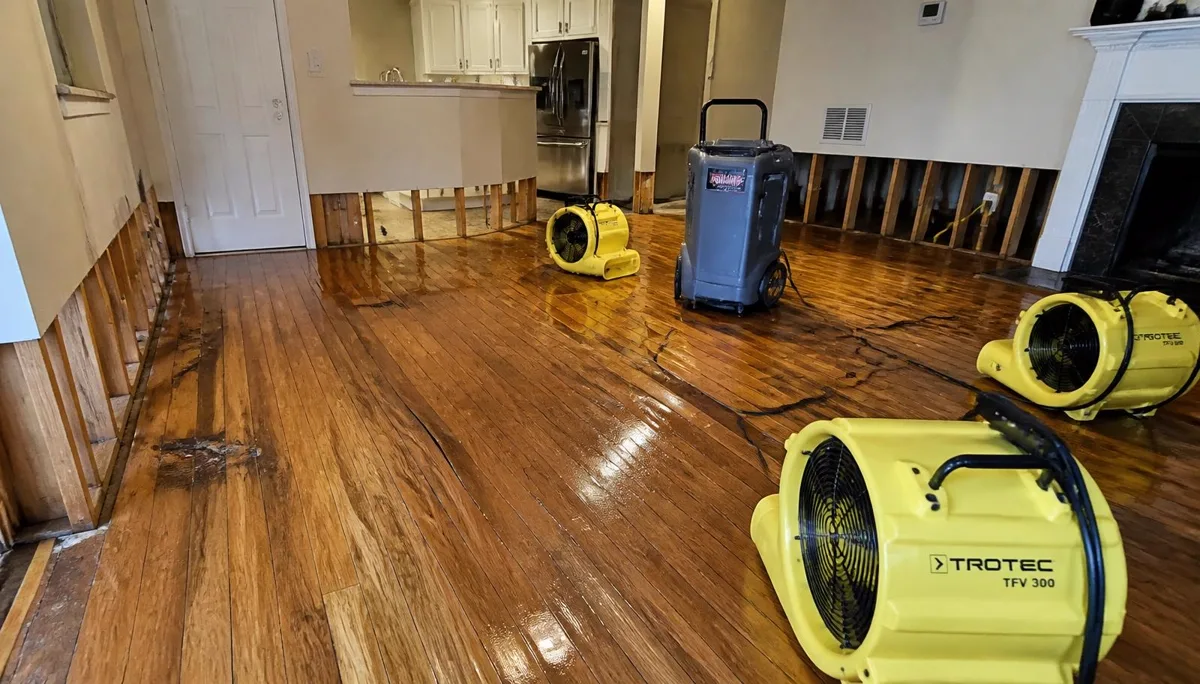
Air movers, dehumidifiers and daily documented readings.
Clearance testing and repair
Dry standard confirmed, then rebuild and finish work.
We work directly with your insurance carrier
Claims are won or lost on documentation. From the first hour we photograph the source, log the affected materials and record the water category, so your adjuster sees a sudden, accidental loss rather than a maintenance issue.
We take moisture readings in every wet material — subfloor, framing, insulation and drywall cavities — and repeat them daily until each one reaches documented dry standard. Those logs go straight into the claim file.
We bill your carrier directly using industry-standard estimating software, so you pay your deductible and nothing more on covered work. If hidden damage appears during demolition, we file the supplement for you.
What your adjuster will ask for
- Date and cause of loss, in writing
- Photos of the source and all affected rooms
- Initial and daily moisture readings
- Line-item scope of extraction and drying
- Equipment log with placement and run time
Orange County cities we serve
Crews stage from Irvine, Huntington Beach and Mission Viejo, which puts every city below inside a 60-minute response window at any hour. Coverage runs from Yorba Linda and Anaheim Hills in the north through the central cities to San Clemente on the south coast.
- Irvine
- Huntington Beach
- Newport Beach
- Costa Mesa
- Mission Viejo
- Yorba Linda
- Anaheim Hills
- Laguna Niguel
- Lake Forest
- Tustin
- San Clemente
- San Juan Capistrano
- Fullerton
- Santa Ana
- Dana Point
- Aliso Viejo
Request a free inspection
Tell us what happened and where. A restoration manager calls you back immediately, day or night, and a crew can be on site within the hour anywhere in Orange County.
Or call now — someone answers 24/7: (949) 555-0142
Mold Remediation in Orange County: common questions
Does homeowners insurance cover water damage?
Most California homeowners policies cover sudden and accidental water damage, such as a burst supply line or a failed water heater. Gradual leaks, long-term seepage and flooding from outside the home are typically excluded and need separate flood coverage. We document the loss with moisture readings and photos on day one so your carrier can see the damage was sudden.
How long does structural drying take?
Three to five days is typical for a single-room loss with hardwood or drywall involvement. Dense materials such as plaster, lath and concrete can take longer. We take daily moisture readings and only remove equipment when materials reach documented dry standard.
What is Category 3 water?
Category 3 is grossly contaminated water: sewage backups, rising ground water and toilet overflows past the trap. It requires containment, removal of porous materials such as carpet, pad and drywall, and antimicrobial treatment before drying.
How fast can a crew reach my property?
We target on-site arrival within 60 minutes anywhere in Orange County, 24 hours a day, including weekends and holidays. Call and you will be told a time rather than a window.
Do I have to pay before insurance approves the claim?
No. We bill your carrier directly for covered work and collect only your deductible. You receive the same line-item estimate the adjuster reviews, in the industry-standard format carriers settle from.
Should I turn off the water myself?
Yes, if you can reach the main shutoff safely. Do not enter standing water where outlets or panels are submerged. Call us and we will walk you through it on the phone.
Can wet drywall be saved?
Sometimes. Clean water on painted drywall that has not lost structural integrity can often be dried in place with cavity drying. Saturated, delaminated or contaminated drywall is removed.
How do you test for mold after a leak?
We inspect with moisture meters and thermal imaging, and when growth is suspected we coordinate independent air and surface sampling. Clearance testing after remediation is performed by a third party, never by us.
31 more questions about water damage, mold and insurance claims