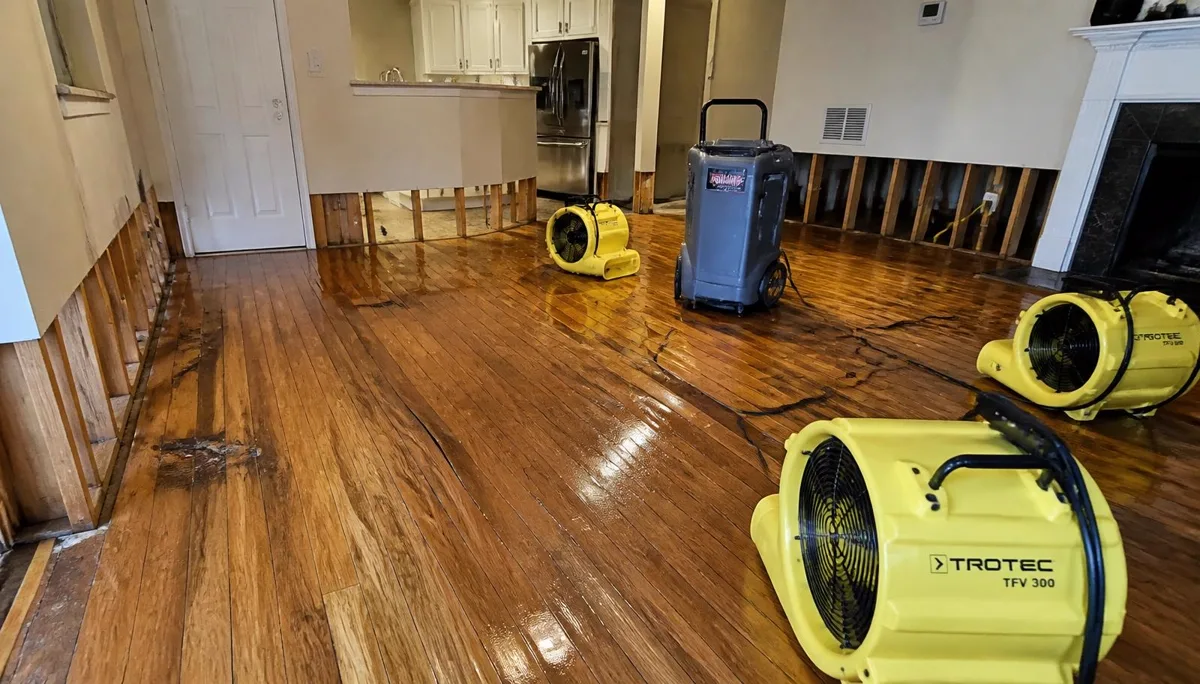
What Water Damage Restoration Costs in Orange County
Most people who search this have a number in their hand and no way to judge it. This page is about how that number gets built, which is the only thing that lets you tell a fair quote from a bad one.
- 20 years restoring Orange County properties
- Drying documented to the IICRC S500 standard, billed to your insurer
- On site in 60 minutes, 24 hours a day
Part of Water Damage Restoration in Orange County, from Orange County Rapid Restoration. We handle this across the county, 24 hours a day.
The four bands most Orange County jobs fall into
One wet room from a supply line or a failed appliance runs $1,200 to $3,500 and three to five days of drying. Water that tracked under the walls into adjoining rooms runs $3,500 to $9,000 over five to eight days, because cavity drying and baseboard removal get added to the same work. A Category 3 loss — sewage, or ground water that came in from outside — runs $7,000 to $18,000 and one to two weeks, since containment, disposal of porous materials and third-party clearance all attach to it. Mold remediation that follows a leak is its own scope at $2,500 to $12,000.
Those bands are wide on purpose. The width is the honest part: the same square footage can sit at either end depending on what the water touched, and any company that quotes a firm price before taking a moisture reading is quoting a guess and will supplement later.
Square footage is the wrong unit, and the industry knows it
A 200-square-foot bathroom with a wet plaster wall and a hardwood threshold costs more to dry than 800 square feet of wet tile on a slab. Floor area does not tell you how much water a material is holding or how hard it is to pull back out, and those two things are the entire cost of the mitigation half of the job.
The IICRC S500 standard the trade estimates against does not classify losses by area either. It classifies them by evaporation load — Class 1 is a loss where less than about five percent of the combined floor, wall and ceiling surface is wet porous material; Class 2 is five to forty percent; Class 3 is above forty percent, usually because the water came from overhead; Class 4 is water bound deep in low-evaporation materials such as hardwood, plaster, concrete or stone, and it needs specialty equipment and more days. A per-square-foot figure collapses all four into one number and is worth exactly what it costs to produce.
Two words decide most of the price: category and class
Category is how contaminated the water is. Category 1 is clean, from a sanitary source such as a supply line or a water heater. Category 2 is significantly contaminated — dishwasher or washing machine discharge, or a toilet overflow that did not pass the trap. Category 3 is grossly contaminated: sewage, rising ground water, seawater. Category is what decides whether carpet, pad and drywall have to leave the building or can be dried in place, and that single decision moves the price more than anything else on the estimate.
Class, as above, is how much wet porous material there is and how hard it is to dry. Category sets what comes out. Class sets how much equipment runs and for how many days. Everything else on the estimate is downstream of those two letters, which is why an estimator who cannot tell you the category and class of your loss has not actually assessed it.
A franchise quote and an independent quote are built in the same software
Most carriers settle water losses through Xactimate, and most restoration firms — franchise and independent alike — estimate in it, at unit prices the carrier's own price list sets for this ZIP code. The line item for an air mover per day is not something a company invents. This is why the honest answer to whether a national brand is overpriced is: not usually on unit price, and sometimes on scope.
Scope is where two quotes on the same house end up thousands apart. How many air movers, for how many days. Whether the wall cavity was billed as cavity drying or the wall was simply cut out. Whether daily monitoring was billed, and whether the readings that justify it are attached. Whether the rebuild is inside the same number or is a separate estimate you have not seen yet. Compare those lines, not the totals.
The lines worth checking on any estimate you receive
Equipment days, stated as a count times a number of days rather than a lump. Daily monitoring, with the moisture log attached — if a company billed for readings, you are entitled to the readings. Containment and negative air, which belong on a Category 3 or a mold scope and do not belong on a clean single-room loss. Antimicrobial application, which is a real line and is also the one most often applied to surfaces where it does nothing.
Then look for what is missing. An estimate with no mention of the rebuild is half a project. An estimate that dries a hardwood floor in three days has not accounted for Class 4 water, and the floor will cup after the equipment leaves. We would rather you find these before you sign than after.
How water damage restoration works, start to finish
Emergency call
24/7 dispatch, shutoff guidance and crew assignment.
Inspection and moisture mapping
Meters and thermal imaging map every wet material.
Water extraction
Truck-mount and portable extraction of standing water.
Structural drying
Air movers, dehumidifiers and daily documented readings.
Clearance testing and repair
Dry standard confirmed, then rebuild and finish work.
Request a free inspection
Tell us what happened and where. A restoration manager calls you back immediately, day or night, and a crew can be on site within the hour anywhere in Orange County.
Or call now — someone answers 24/7: (949) 555-0142
What Water Damage Restoration Costs in Orange County: common questions
How much does Servpro charge for water damage?
Broadly what everyone else charges, because the unit prices come from the carrier's price list for your ZIP code rather than from the company. A franchise quote and an independent quote on the same loss usually differ on scope — equipment count, days on site, how much material was removed — rather than on the rate per line item.
Is Servpro overpriced?
Not on unit price in most cases. The complaints that do hold up are about scope: equipment left running longer than the readings justified, or an estimate that grew after the work started. Both are visible in the moisture log, which is why you should ask for it on any job regardless of who is doing it.
What is the difference between water damage remediation and restoration?
Mitigation, sometimes called remediation, is the emergency half: stopping the water, extraction, controlled demolition and drying. Restoration is putting the building back — drywall, paint, flooring, cabinetry. They are usually two estimates and often two crews, and mixing them into one number is how a quote becomes impossible to compare.
How much does labor cost to repair a water damaged ceiling?
For a straightforward drywall ceiling patch, most of the cost is labor rather than material — the drywall and compound are inexpensive and the texture match and paint are not. What actually decides the number is whether the cavity above it is dry and whether the ceiling contains asbestos, which in a pre-1980 Orange County house has to be tested before anything is cut.
Is ceiling water damage covered by insurance?
Usually yes when the cause was sudden and accidental, such as a supply line above it letting go. Usually no when it was a slow roof leak or a shower pan that has been failing for a year, because that is maintenance. The claim frequently turns on which of those two the adjuster concludes, which is why the first-day photographs and readings matter more than the repair estimate.
What is water damage restoration cost per square foot?
It is a figure that gets published a lot and predicts very little. Two losses of identical area price differently depending on the category of the water, how much porous material is wet, and whether the wet materials are fast-drying or bound. Ask for the category and class of your loss instead — those two answers tell you more than any per-foot number.
Why did two companies quote me numbers twice apart?
Almost always because one scoped a demolition and the other scoped in-place drying, or because one included the rebuild and the other did not. Put the two estimates side by side on the equipment and demolition lines. If the difference is there, one of them is wrong about the category of the water, and that is a question with a right answer.
Do I pay anything if I decide not to go ahead?
Not for the inspection, the moisture readings or the written scope. You keep the numbers either way. We would rather hand you documentation you take somewhere else than charge you to find out whether you have a problem.