Orange County service
Mold Inspection and Testing in Orange County
Inspection finds the moisture and maps the growth. Testing tells you what is in the air. They are different jobs and the second one should never be done by the company that wants the remediation contract.
- 22 years restoring Orange County properties
- IICRC S500 certified technicians who bill your insurer directly
- On site in 60 minutes, 24 hours a day
Orange County Rapid Restoration handles this across the county, 24 hours a day.
What an inspection actually covers
A moisture survey of the affected area and the rooms around it, using pin and pinless meters on framing, drywall and subfloor, plus thermal imaging to find migration behind finishes. Visual inspection of the usual reservoirs: under sinks, behind toilets, at the base of exterior walls, in the attic around penetrations, and at the air handler and its condensate line.
The output is a moisture map and a source. Mold is a symptom; it grows where something is wet and keeps growing until that stops. An inspection that identifies growth without identifying the water is half an inspection.
Why we do not run our own clearance testing
Air and surface sampling goes to an independent accredited laboratory. So does post-remediation verification. The company that performed the removal has an obvious interest in the result, and any firm that offers to test its own work has told you what its testing is worth.
That separation is also what a carrier expects to see in the file. Clearance from a third party is the document that closes a mold claim; clearance from the remediation contractor frequently is not.
When testing is worth paying for and when it is not
If you can see growth and you know the leak, testing usually adds cost without changing the plan — the material comes out either way. Testing earns its money when growth is suspected but not visible, when occupants are reacting and nobody can find a source, when a purchase or a dispute needs documentation, and after remediation to verify the work.
We will tell you which of those you are in before taking a sample.
Our restoration process
Emergency call
24/7 dispatch, shutoff guidance and crew assignment.
Inspection and moisture mapping
Meters and thermal imaging map every wet material.
Water extraction
Truck-mount and portable extraction of standing water.
Structural drying
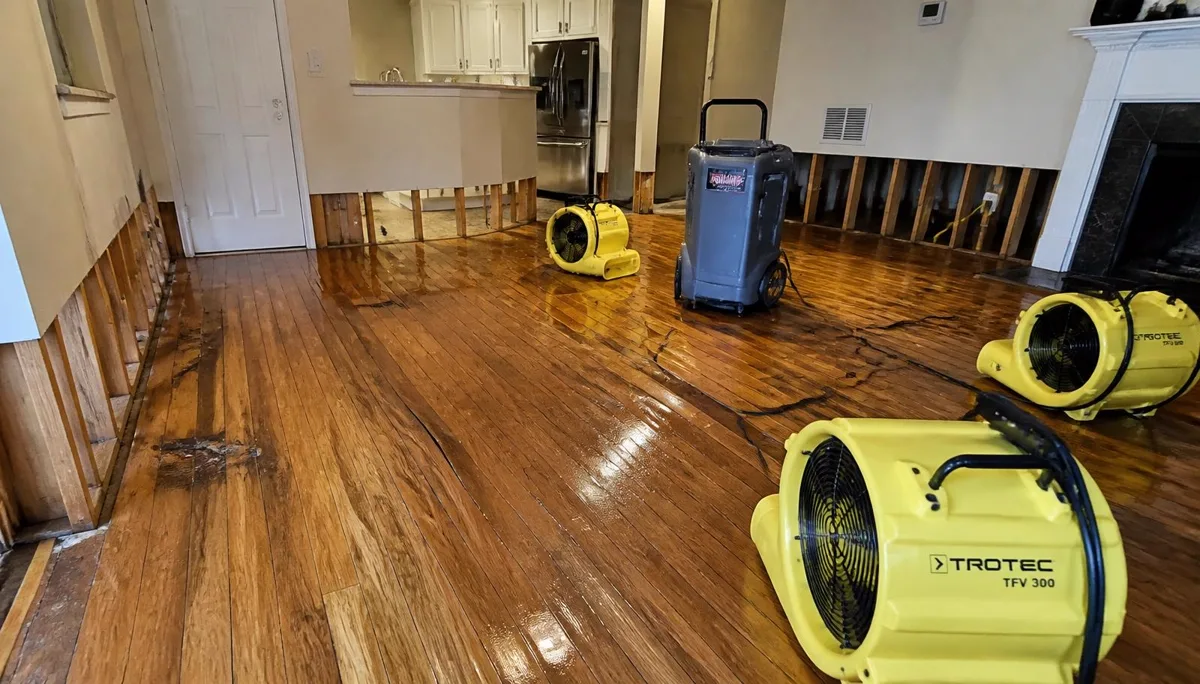
Air movers, dehumidifiers and daily documented readings.
Clearance testing and repair
Dry standard confirmed, then rebuild and finish work.
Request a free inspection
Tell us what happened and where. A restoration manager calls you back immediately, day or night, and a crew can be on site within the hour anywhere in Orange County.
Or call now — someone answers 24/7: (949) 555-0142
Mold Inspection and Testing in Orange County: common questions
How much does it cost to do a mold inspection?
In Orange County, commonly $300 to $600 for a residential inspection with moisture mapping, and $100 to $250 per air sample sent to the lab. Our inspection is free when it follows a water loss we are responding to, because in that case the moisture survey is part of the job rather than a separate product.
What are the signs you need mold testing?
Persistent musty odour with no visible source, occupants with symptoms that improve away from the building, staining that returns after painting, and any water event that went undried for more than about forty-eight hours. Visible growth with a known cause usually does not need testing — it needs removal.
Can a house full of mold be saved?
Almost always. Remediation is a materials problem, not a demolition sentence: porous materials that are contaminated come out, non-porous surfaces are cleaned, and the moisture source is fixed so it does not return. What decides cost is how much porous material is involved, not how alarming it looks.
What time of year is worst for mold in Orange County?
Winter, because that is when rain and roof and drainage failures happen, and because closed-up houses hold humidity. Coastal areas run a second risk through the summer marine layer, where ambient humidity alone keeps materials from drying after a small leak.
What should I not spray on mold?
Bleach on porous material. It removes the colour and leaves the growth in the substrate, so the surface looks clean while the problem continues underneath, and the water in the bleach adds moisture. It also makes later sampling harder to interpret.
Who should collect the samples?
Someone with no financial interest in the result. We coordinate independent sampling and hand you the lab report directly. If a company offers to both test and remediate on its own findings, get a second opinion before authorising anything.