Burst pipe or supply line
Pressurized lines can release hundreds of gallons an hour into walls and flooring.
24/7 Emergency Response — Crews Dispatched in 60 Minutes
(949) 555-0142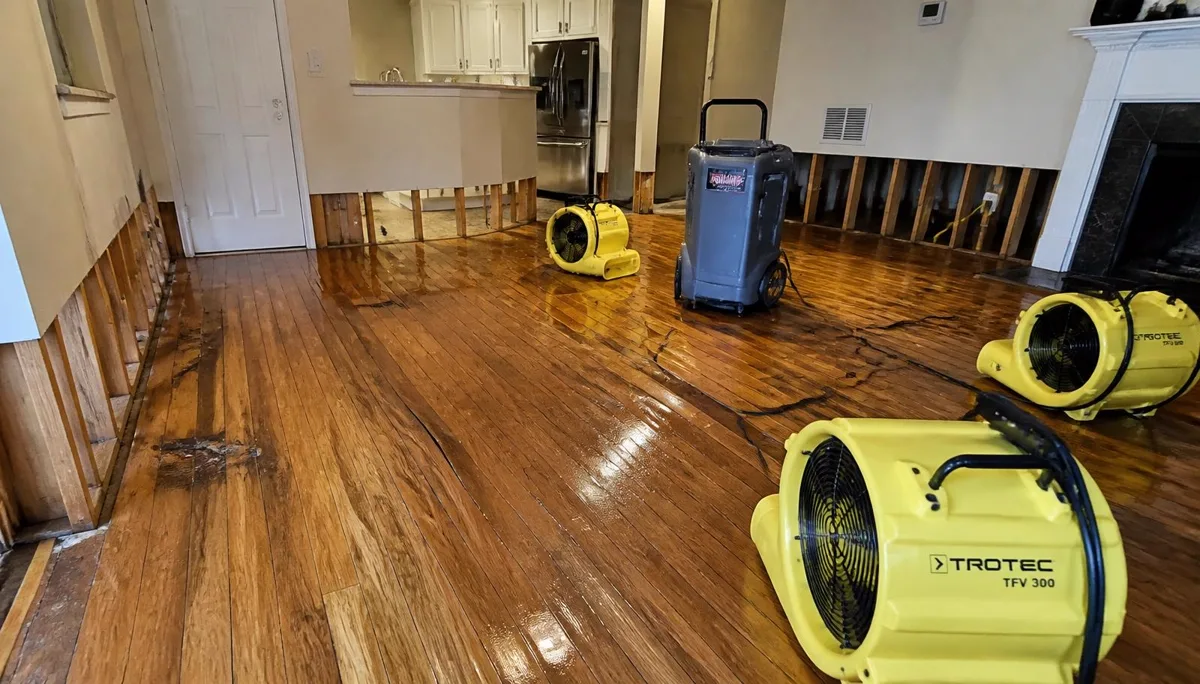
Serving Fullerton, California
Fullerton splits sharply between pre-war neighbourhoods near downtown and post-war tracts, and the two halves fail differently.
Orange County Rapid Restoration dispatches to Fullerton around the clock. What follows is what the losses look like here specifically, and what the response involves.
31%
Homes built before 1960
71%
Built before 1980
52%
Owner-occupied
61%
Single-family homes
Housing figures: US Census ACS tables B25003, B25034, B25024 and B19013, aggregated across Fullerton’s ZCTAs. Water service: City of Fullerton Water Utility.
Thirty-one percent of Fullerton's housing was built before 1960, and much of that older stock sits on a raised foundation with a crawl space rather than on a concrete slab. That difference decides where the water goes. On a slab, a supply failure spreads sideways under the flooring. Over a crawl space it drains down, soaks the soil and the underside of the subfloor, and evaporates back up into the house for weeks.
Crawl space losses are the ones homeowners underestimate, because the floor upstairs dries and feels fine while the joists below stay at high moisture content. We meter from underneath and dry the cavity directly rather than assuming a dry surface means a dry structure.
Fullerton's owner-occupancy sits at fifty-two percent, and a large share of the rental stock near the two campuses turns over annually and sits empty between tenancies. A supply line that fails in an empty unit runs until someone notices, which in an August vacancy can be days rather than hours.
Volume matters at that point. A failed half-inch line at typical municipal pressure moves two to four hundred gallons an hour. Three days unattended is not a drying job; it is a demolition and rebuild.
Pick the closest match. Every situation below is handled by our crews tonight.
Pressurized lines can release hundreds of gallons an hour into walls and flooring.
Warm spots, high water bills and buckling floors usually mean a leak under the slab.
Tank ruptures flood garages and adjacent rooms, often soaking shared drywall.
Condensate lines clog and drip into ceilings for weeks before the stain appears.
Dishwashers, washing machines and supply valves fail without warning.
Category 3 water requires containment, removal of porous materials and sanitizing.
Insulation holds moisture long after the rain stops and hides active growth.
Visible growth after a water event needs containment before any repair work.
Claims are won or lost on documentation. From the first hour we photograph the source, log the affected materials and record the water category, so your adjuster sees a sudden, accidental loss rather than a maintenance issue.
We take moisture readings in every wet material — subfloor, framing, insulation and drywall cavities — and repeat them daily until each one reaches documented dry standard. Those logs go straight into the claim file.
We bill your carrier directly using industry-standard estimating software, so you pay your deductible and nothing more on covered work. If hidden damage appears during demolition, we file the supplement for you.
24/7 dispatch, shutoff guidance and crew assignment.
Meters and thermal imaging map every wet material.
Truck-mount and portable extraction of standing water.
Air movers, dehumidifiers and daily documented readings.
Dry standard confirmed, then rebuild and finish work.
Tell us what happened and where. A restoration manager calls you back immediately, day or night, and a crew can be on site within the hour anywhere in Orange County.
Or call now — someone answers 24/7: (949) 555-0142
Yes. Standing water under a raised foundation raises the humidity of everything above it, and the joists and subfloor absorb from below where nobody looks. The floor upstairs can feel completely dry while the structure underneath sits at high moisture content and starts growing.
On a slab the water spreads sideways and dries from one face. In a crawl space it soaks the soil, and the soil keeps releasing moisture upward for weeks. We dry the cavity directly with containment and dehumidification rather than treating the floor above as the problem.
It depends entirely on how long it ran. A failed half-inch supply line moves two to four hundred gallons an hour. A weekend is a drying job with demolition; a two-week vacancy is a rebuild, because at that point the drywall, insulation, cabinetry and subfloor have all been wet past saving.
Completely. Thirty-one percent of the city predates 1960, and that stock brings raised foundations, cast-iron drains and surviving galvanized branch lines. The post-war tracts are slab-on-grade with copper. Different foundation, different water path, different demolition plan.
It is a fitting that separates copper from galvanized steel so the two metals do not corrode where they touch. Houses that were partially repiped over the years often join the two directly without one, and that junction corrodes and fails — usually inside a wall, years later.
Fullerton runs its own water utility rather than buying through a district, so a main-side leak or a meter question goes to the City of Fullerton Water Utility. Anything on the house side of the meter is the property owner's, and that is the majority of what we see.
Yes, and with fifty-two percent owner-occupancy in Fullerton we do it often. Emergency mitigation proceeds on the manager's authorisation to stop the loss growing. The rebuild scope and the insurance file need the owner, which we handle in parallel rather than waiting.
Longer than a room above a slab — commonly seven to ten days, because the soil holds water and releases it slowly. We meter the joists and subfloor rather than the air, and equipment stays until the wood reaches documented dry standard.