Burst pipe or supply line
Pressurized lines can release hundreds of gallons an hour into walls and flooring.
24/7 Emergency — 60 Minutes24/7 Emergency Response — Crews Dispatched in 60 Minutes
(949) 555-0142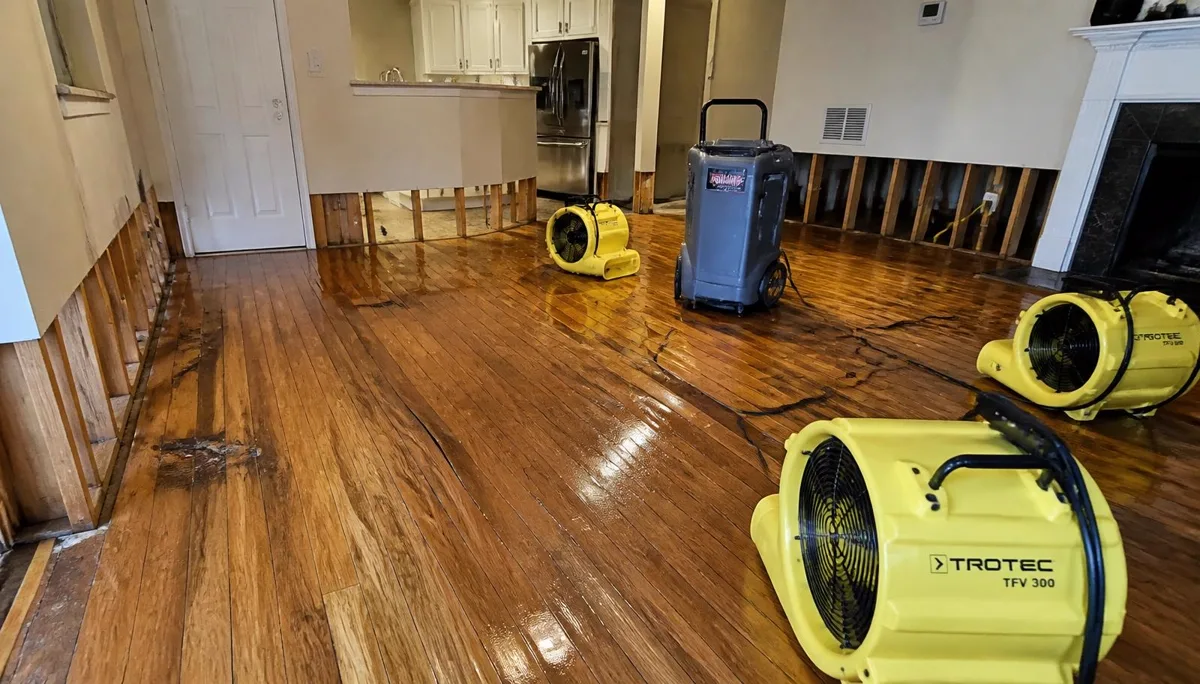
Santa Ana has the oldest housing stock in Orange County, and the failures here are the ones that come with age rather than the ones that come with new construction.
Orange County Rapid Restoration dispatches to Santa Ana around the clock. What follows is what the losses look like here specifically, and what the response involves.
33%
Homes built before 1960
75%
Built before 1980
49%
Owner-occupied
$99,540
Median household income
Housing figures: US Census ACS tables B25003, B25034, B25024 and B19013, aggregated across Santa Ana’s ZCTAs. Water service: City of Santa Ana Public Works Water Resources Division.
Thirty-three percent of Santa Ana's housing predates 1960 and seventy-five percent predates 1980. That is the highest share of pre-war and mid-century stock of any city we cover, and it changes what fails. Homes from that era were plumbed in galvanized steel, which corrodes from the inside until the interior diameter closes and a pinhole opens at a threaded joint, and drained through cast iron, which rusts through at the hub.
A galvanized pinhole does not announce itself. It sprays a fine mist inside a wall cavity for weeks, and the first sign is usually a musty smell or paint lifting at a baseboard rather than water on the floor. By the time it is visible, the framing behind it has been wet long enough for growth to establish.
At forty-nine percent owner-occupancy, Santa Ana has more renters than owners. In a rental the person who sees the water is not the person who authorizes the work, and the delay between those two calls is where a contained loss becomes a category upgrade. Clean water becomes contaminated at around forty-eight hours.
We work the loss from the first call regardless of who is on the phone. Emergency mitigation stops the damage spreading and does not require a signature from an owner who is unreachable at nine at night. Scope and authorization for the rebuild follow in daylight.
Pick the closest match. Each of these is a loss this service covers, at any hour.
Pressurized lines can release hundreds of gallons an hour into walls and flooring.
Warm spots, high water bills and buckling floors usually mean a leak under the slab.
Tank ruptures flood garages and adjacent rooms, often soaking shared drywall.
Condensate lines clog and drip into ceilings for weeks before the stain appears.
Dishwashers, washing machines and supply valves fail without warning.
Category 3 water requires containment, removal of porous materials and sanitizing.
Insulation holds moisture long after the rain stops and hides active growth.
Visible growth after a water event needs containment before any repair work.
24/7 dispatch, shutoff guidance and crew assignment.
Meters and thermal imaging map every wet material.
Truck-mount and portable extraction of standing water.
Air movers, dehumidifiers and daily documented readings.
Dry standard confirmed, then rebuild and finish work.
Claims are won or lost on documentation. From the first hour we photograph the source, log the affected materials and record the water category, so your adjuster sees a sudden, accidental loss rather than a maintenance issue.
We take moisture readings in every wet material — subfloor, framing, insulation and drywall cavities — and repeat them daily until each one reaches documented dry standard. Those logs go straight into the claim file.
We bill your carrier directly using industry-standard estimating software, so you pay your deductible and nothing more on covered work. If hidden damage appears during demolition, we file the supplement for you.
Tell us what happened and where. A restoration manager calls you back immediately, day or night, and a crew can be on site within the hour anywhere in Orange County.
Or call now — someone answers 24/7: (949) 555-0142
Look at the supply line entering the water heater or under a sink. Galvanized steel is dull gray, magnetic and threaded at the fittings. Copper is orange-brown and soldered. With a third of the city built before 1960, a house that has never been repiped almost certainly still has some.
Usually yes, and it is a warning. Galvanized pipe corrodes inward, so the interior diameter closes gradually and pressure falls before anything leaks. A house that has slowly lost pressure over a decade is a house whose pipe walls are thin, and thin walls open at threaded joints first.
Call us and call your landlord, in that order if the water is active. Work on someone else's property needs the owner's authorization, so reach the owner or manager first — that call is the thing that unblocks a crew, and it is worth making at any hour rather than waiting until morning. Photograph everything before anything is moved — as a tenant your contents claim depends on it.
A supply line is pressurized, so it sprays and floods quickly. Cast iron is a drain, so it fails slowly at the hub where the pipe joins, and it releases contaminated water. That makes it a Category 3 loss requiring containment and removal of porous materials rather than a straight drying job.
That is the signature of a pinhole in a wall cavity, which is the most common failure in pre-1960 plumbing. A fine mist sprays inside the wall for weeks. The framing and insulation are wet, growth has started, and none of it is visible until the paint lifts or the baseboard swells.
They can, and age invites the argument. What answers it is day-one evidence: photographs of the failure point, moisture readings showing a recent wetting pattern rather than long-standing saturation, and a written scope. We produce all three as standard because in older housing we expect the question.
The City of Santa Ana Public Works Water Resources Division runs its own system rather than buying through a district. A leak on the street side of the meter is theirs. Everything past the meter belongs to the property, and that covers nearly every loss we respond to.
Under an hour at any time of day. Santa Ana sits centrally in the county, so it is one of the shorter runs from our staging points. If water is still moving when you call, we will talk you through shutting the main off while the crew is on the way.